
AI vs. Virtual Assistants: Prove Your Value in 2026
VA TIPSVIRTUAL ASSISTANT SKILLS
Roi Capao
3/22/202620 min read


We have all seen remote work completely change how businesses run today. If you are thinking about starting a career from home, becoming a Virtual Assistant in the Philippines remains a truly excellent career move. Our local remote talent pool has grown beautifully because clients appreciate the strong English skills and the incredible dedication Filipino professionals bring to the table. But we are facing a new hurdle. The quick spread of cheap artificial intelligence software tests the classic client and freelancer relationship.
When we handle repetitive administrative tasks, cheap software subscriptions pose a direct threat. This change in technology usually leads to tricky moments with our clients, mostly when they review their budgets or try to save money. Imagine this situation. A client looks at their financial statements and starts a tough conversation about their expenses.
The conversation usually rests on a very specific financial question. The client asks, "I love your work, but I am looking at my expenses and I need to cut back. Why should I keep you instead of using an AI tool that costs $20 a month?"
Your response to this exact question determines the future of your remote career. It decides if you keep your contract or get replaced by a monthly software bill. We will look closely at the current market for virtual assistants in the Philippines and list the specific AI tools threatening administrative jobs. We will also examine why common defensive answers fail and outline a strong plan to help you change from a simple task executor into an expert revenue partner.
The State of Virtual Assistants in the Philippines in 2026
To fully grasp the threat of artificial intelligence, we first need to understand the current situation of our industry. The Philippines has solidified its standing as a primary source of outsourced talent. The industry has moved past basic call center operations and split into highly specific home based assistance covering complex technical, financial, and marketing support.
Current market trends point out that businesses globally rely heavily on distributed teams to maintain continuous operations. The push for cost efficiency largely drives this shift. That same desire to save money pushes clients to look at AI software.
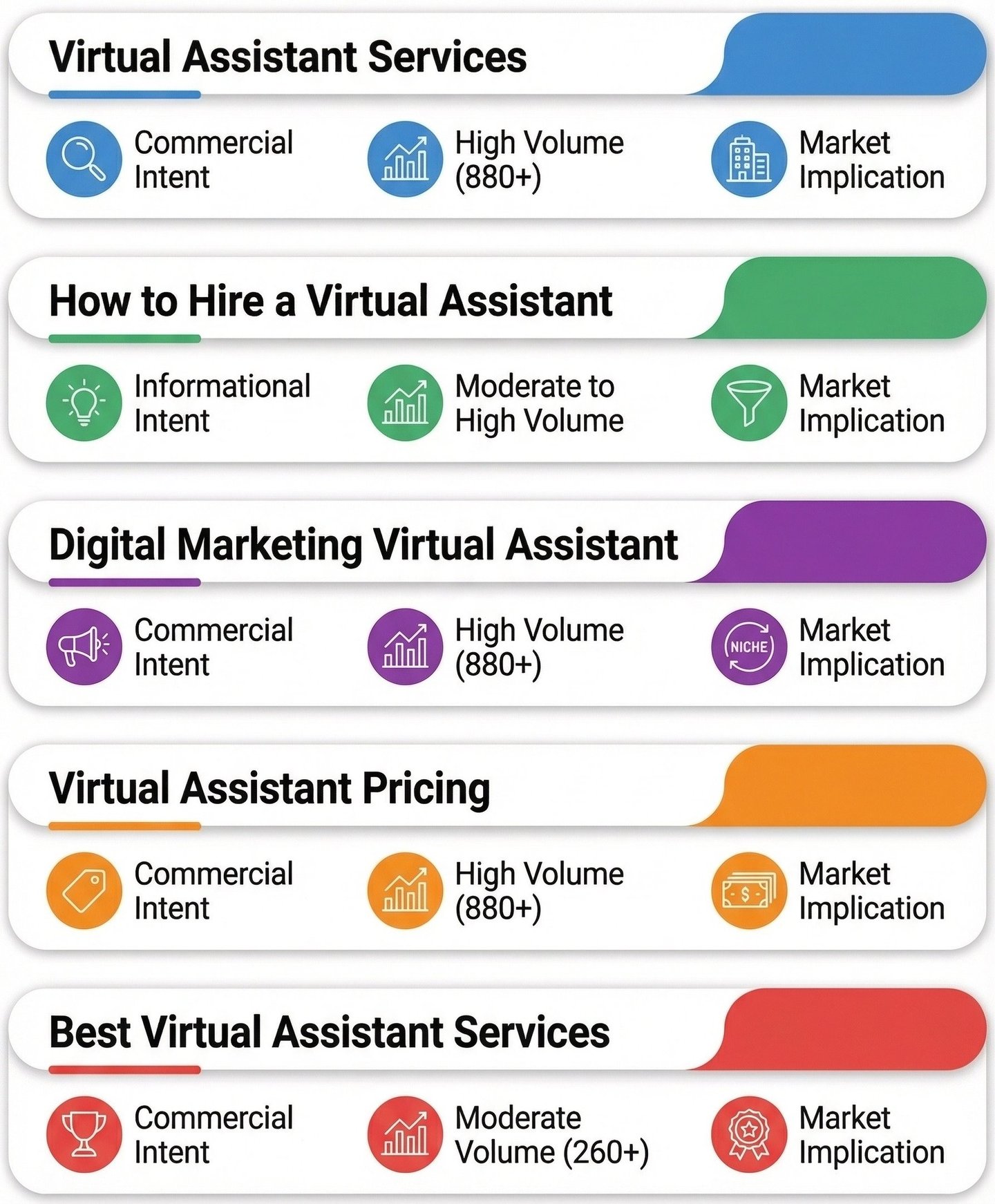
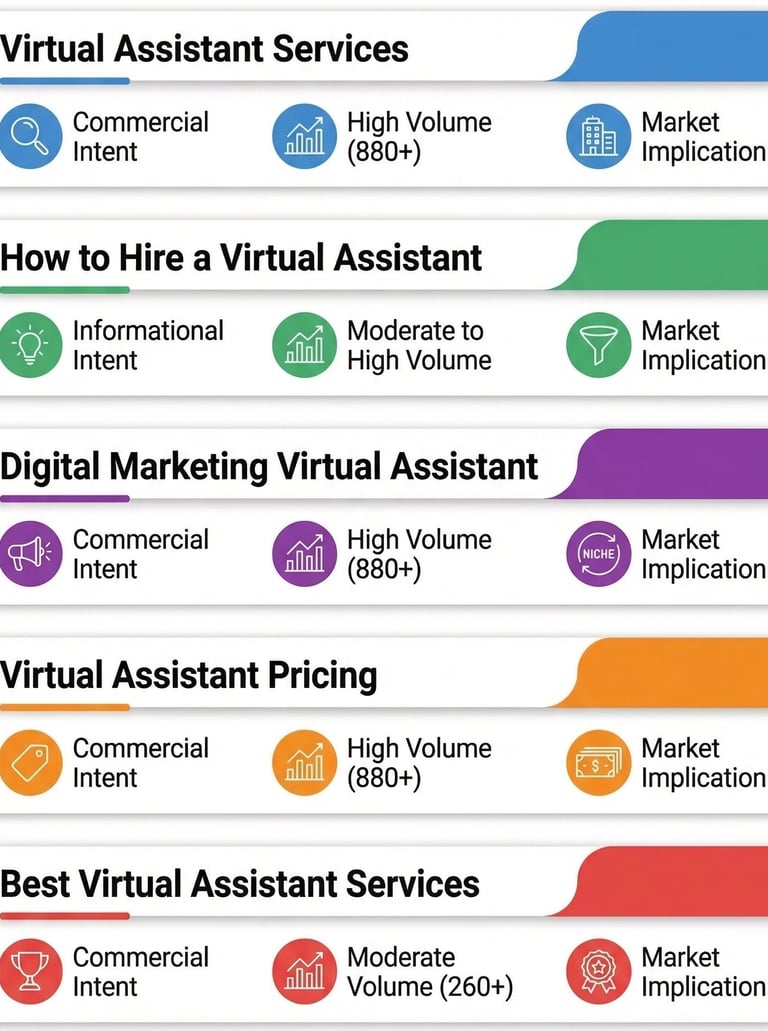
A close look at search engine optimization data and search marketing trends reveals deep commercial intent from business owners looking for remote help. Reviewing the most popular SEO keywords for virtual assistants in the Philippines gives us great clarity into what clients prioritize when they hire.
The data proves the demand for virtual assistants in the Philippines remains exceptionally strong. Thousands of foreign employers utilize massive remote job boards such as OnlineJobs.ph, Kalibrr, and Jobstreet to source offshore teams for customer support, ecommerce, and executive assistance. Analysts describe the local scene in 2026 as heavily influenced by AI adoption and data driven filtering. Businesses experience macroeconomic pressures, including stubborn inflation and elevated interest rates, which squeeze profit margins and force aggressive cost cutting measures.
In this constrained financial environment, human virtual assistants no longer compete solely against other freelancers. We compete against the perceived efficiency of automated software. To successfully handle this environment, Filipino virtual assistants must possess an exhaustive understanding of exactly what these AI tools are, the limits of their capabilities, and precisely where their programming fails.
The AI Threat Matrix: Analyzing the $20 Monthly Competitors
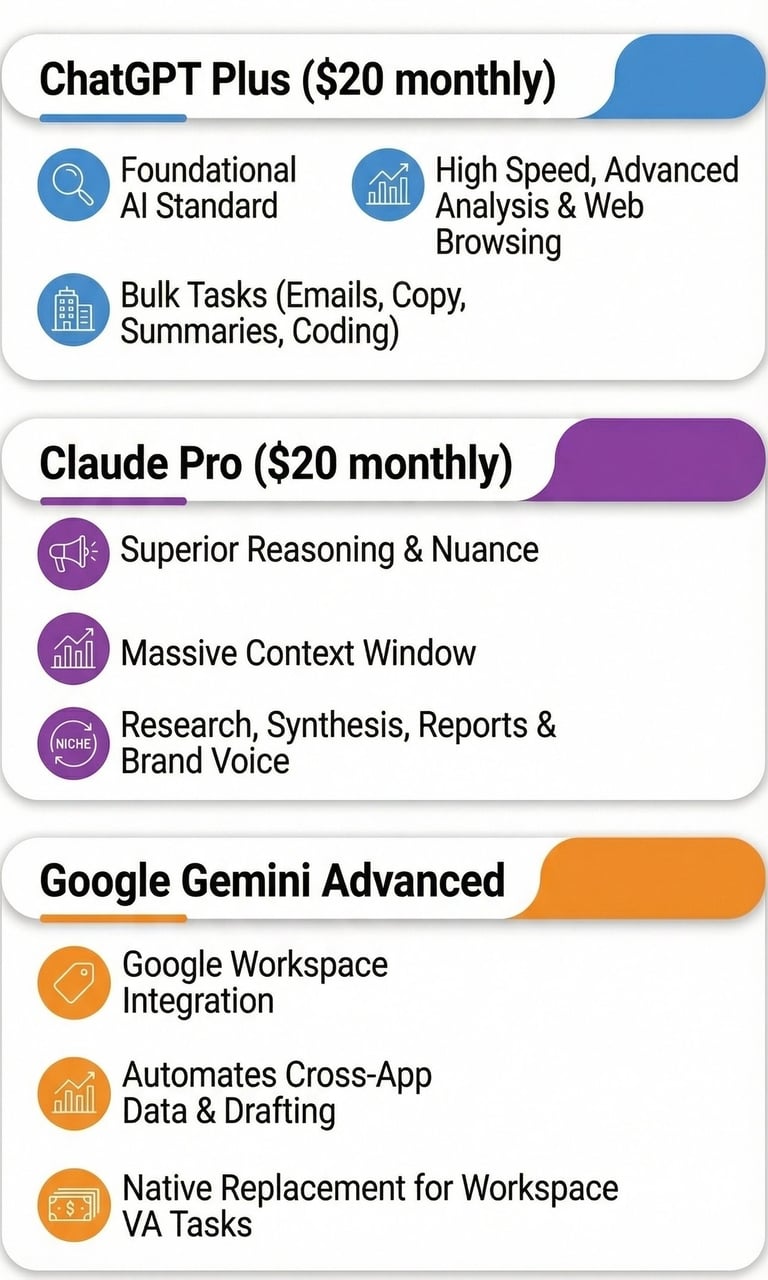
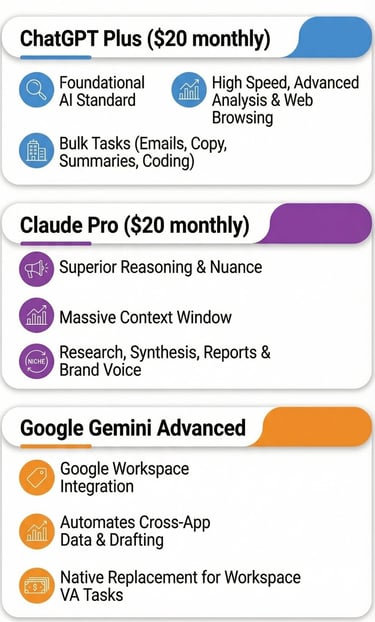
When a client references a $20 a month AI tool during a budget negotiation, they usually mean the current generation of premium Large Language Models or specialized AI applications engineered to streamline specific business areas. These tools have rapidly advanced past simple chatbots. They now connect deeply to enterprise software, internal databases, calendars, and external communication platforms.
To effectively counter the argument that AI can easily replace human labor, a professional must abandon generalized statements about technology. You must maintain a highly specific technical understanding of the tools dominating the market.
Key Takeaways
The Threat Is Real But Manageable: Cheap software subscriptions for twenty dollars a month are actively changing how clients view their administrative budgets. We cannot ignore this shift in technology.
Avoid Defensive Reactions: When a client brings up budget cuts, the worst things you can do are beg based on loyalty, immediately drop your rates, or attack the software as useless. These reactions only hurt your perceived value.
Expose the Hidden Flaws of Automation: Artificial intelligence is far from perfect. It requires a massive setup effort, constantly makes up fake facts, poses severe data privacy risks, and completely lacks the emotional intelligence needed to keep a team and customers happy.
Become the Expert Manager: Instead of competing against the machine on speed, you need to step up and manage it. Show your client that you will operate the software to save time, then use that saved time to focus on activities that actually generate revenue for their business.
Specialization Is Your Best Defense: General data entry roles are fading away. We must upgrade our skills into specific areas like email marketing strategy, data analysis, or real estate operations. Mastering advanced techniques like layered prompt engineering makes you totally irreplaceable.
General Purpose and Content Generation AI
Specialized Operational AI Tools by Niche
Beyond general content creation, highly specialized AI applications actively target distinct niches. These platforms use narrow AI to execute specific workflows, often utilizing aggressive pricing models highly appealing to budget conscious clients aiming to streamline operations.
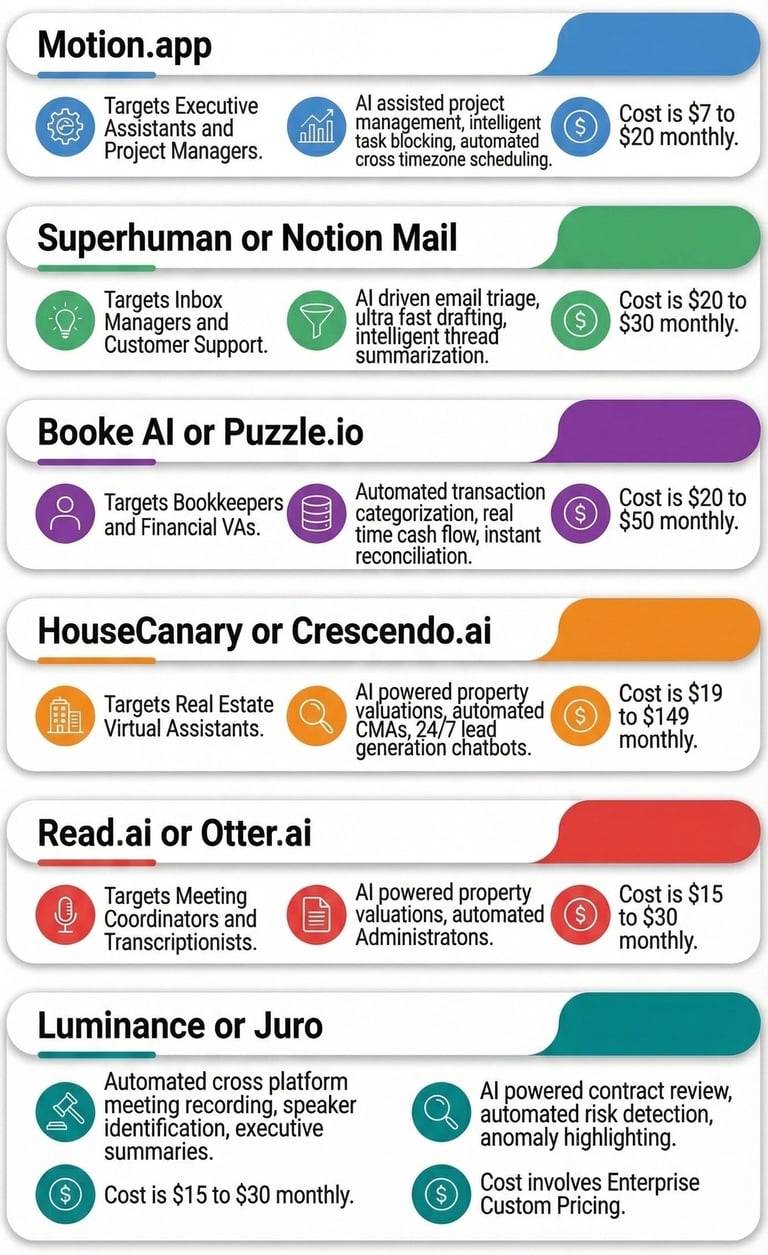
The computational capability and raw speed of these tools are undeniable. They are exceptionally scalable, operating continuously without the constraints of human fatigue, time zones, or the need for benefits and vacation time. They are fundamentally software programs tightly bounded by their initial programming, training data, and the precise nature of the inputs they receive. They entirely lack autonomous human judgment, the nuanced ability to handle complex interpersonal or political business relationships, and the capacity to take final professional ownership of a project's final success or catastrophic failure.
Deconstructing the ROI Justification Test: Analyzing Ineffective VA Responses
When confronted with the stark reality of the tools listed above, virtual assistants frequently commit critical strategic and psychological errors during client negotiations. In an attempt to defend their livelihood, they deploy arguments that inadvertently validate the client's desire to automate the role.
Understanding these pervasive pitfalls is essential for preserving the client relationship. We will look at an exhaustive analysis of the weakest and most common responses to the budget cut question, detailing precisely why each approach in the end undermines the professional's perceived value and leads to contract termination.
Weak Response 1: The Emotional Plea
"AI cannot provide the human touch, loyalty, empathy, and cultural understanding that I bring to your brand every single day. I care about your business in a way a machine never will, and I have been fiercely loyal to your company's mission."
The Statement
Why It Fails
A client actively reviewing a spreadsheet to identify operational cost reductions operates exclusively within a framework of business logic, not sentiment. If a client determines that an AI tool can execute a specific administrative task 80% as effectively as a human, but at merely 2% of the financial cost, the intangible, unquantifiable value of the human touch is rarely deemed sufficient to justify the massive premium expense. By relying on this emotional defense, the virtual assistant positions themselves as a sympathetic subordinate rather than a calculating, indispensable business asset. Business relationships are in the end transactional. Loyalty does not balance a budget.
This approach represents a fundamental misalignment of priorities. It relies entirely on soft metrics and emotional appeal when the client is analyzing hard financial data. While loyalty, empathy, and a strong work ethic are highly prized traits heavily associated with the Filipino remote workforce, they do not address the client's primary objective of fiscal efficiency and expense reduction.a
Weak Response 2: Devaluing Skills and Immediate Discounting
The Statement
"I completely understand that your budget is tight right now. To help you through this, I am willing to lower my hourly rate temporarily to match your current constraints until your revenue increases again, just so I can keep working with you."
Why It Fails
This response is fatal to a freelance career because it instantly commoditizes the professional's services and permanently destroys their perceived market value. By immediately slashing rates in response to the mere mention of a technological threat, the virtual assistant inadvertently signals to the client that their previous pricing structure was entirely arbitrary. It communicates that the VA's time and expertise are not strictly essential, and that their services are interchangeable with a cheap software subscription
This initiates an inescapable race to the bottom. Once a rate is significantly reduced under duress, reinstating the original higher fee in the future becomes nearly impossible. The client has now permanently anchored the financial value of the work to the new discounted price point. Financial desperation, while a stark reality for many independent contractors facing the loss of 50% of their income in a single week, must never be leveraged as a transparent negotiation tactic.
Weak Response 3: The Defensive and Combative Stance
The Statement
"AI is entirely unreliable and overhyped. It makes constant mistakes, it hallucinates fake facts, and its writing sounds robotic and generic. If you fire me to use ChatGPT, your business will suffer immensely, your clients will notice, and you will end up coming back to me to fix the massive mess the AI creates."
Why It Fails
It is factually correct that current AI models suffer from severe hallucinations and can produce highly generic, easily identifiable output. Aggressively attacking the client's proposed solution is a profound psychological misstep. Clients exploring AI adoption are often highly motivated by the technology's potential to scale their operations and are seeking validation for their strategic pivot.
Telling a business owner that their proposed strategy is foolish or destructive instantly alienates them. It frames the virtual assistant as an insecure, legacy minded adversary who is stubbornly resistant to innovation and modernization. If the client proceeds to implement the AI and finds it even marginally successful for highly basic, repetitive tasks, the virtual assistant's credibility is permanently shattered, and they are viewed as alarmist and obsolete. The professional must match the client's overarching goal of operational efficiency, not directly combat it.
Weak Response 4: Passive Surrender and Relinquishing Control
The Statement
"If you feel the AI can handle the workload and you need to cut costs, I completely understand. Just let me know when my final day is, and I will prepare the final handover files and standard operating procedures so you can run the system yourself."
Why It Fails
Attempting to compete with a machine on raw processing speed, data ingestion, and output volume is a guaranteed trajectory toward rapid burnout, declining quality, and total professional failure. An AI platform can generate fifty marketing emails, summarize a two hour meeting, and schedule three cross timezone appointments in a matter of seconds. A human being, restricted by cognitive limits and the need for rest, cannot.
Promising to match the velocity of specialized software sets impossible, unsustainable operational expectations. When the virtual assistant inevitably fails to deliver machine level speed and volume over a sustained period, the client will rightfully terminate the contract based on poor performance and unfulfilled promises. The core value of a human worker must be firmly anchored in quality assurance, strategic judgment, and nuanced execution, never in sheer brute force processing power. This dynamic relates directly to the classic Project Management Triangle of Speed, Cost, and Quality. Clients often falsely believe AI provides all three simultaneously. Human professionals must remind them that attempting to maximize all three usually results in catastrophic quality failure.
Weak Response 5: The False Equivalence (Competing on Speed and volume)
The Statement
"You don't need the AI because I can work just as fast. I will increase my output, work longer hours, and guarantee you get the massive volume of content and data processing you need without raising my current rates."
Why It Fails
Attempting to compete with a machine on raw processing speed, data ingestion, and output volume is a guaranteed trajectory toward rapid burnout, declining quality, and total professional failure. An AI platform can generate fifty marketing emails, summarize a two hour meeting, and schedule three cross timezone appointments in a matter of seconds. A human being, restricted by cognitive limits and the need for rest, cannot.
Promising to match the velocity of specialized software sets impossible, unsustainable operational expectations. When the virtual assistant inevitably fails to deliver machine level speed and volume over a sustained period, the client will rightfully terminate the contract based on poor performance and unfulfilled promises. The core value of a human worker must be firmly anchored in quality assurance, strategic judgment, and nuanced execution, never in sheer brute force processing power. This dynamic relates directly to the classic Project Management Triangle of Speed, Cost, and Quality. Clients often falsely believe AI provides all three simultaneously. Human professionals must remind them that attempting to maximize all three usually results in catastrophic quality failure.
Weak Response 6: The "I am Learning It" Excuse (Unpreparedness)
The Statement
"I know AI is important, and I am actually planning to take a course on how to use ChatGPT next month. If you give me a little time to learn it, I can implement it for you so you don't have to hire someone else."
Why It Fails
Attempting to compete with a machine on raw processing speed, data ingestion, and output volume is a guaranteed trajectory toward rapid burnout, declining quality, and total professional failure. An AI platform can generate fifty marketing emails, summarize a two hour meeting, and schedule three cross timezone appointments in a matter of seconds. A human being, restricted by cognitive limits and the need for rest, cannot.
Promising to match the velocity of specialized software sets impossible, unsustainable operational expectations. When the virtual assistant inevitably fails to deliver machine level speed and volume over a sustained period, the client will rightfully terminate the contract based on poor performance and unfulfilled promises. The core value of a human worker must be firmly anchored in quality assurance, strategic judgment, and nuanced execution, never in sheer brute force processing power. This dynamic relates directly to the classic Project Management Triangle of Speed, Cost, and Quality. Clients often falsely believe AI provides all three simultaneously. Human professionals must remind them that attempting to maximize all three usually results in catastrophic quality failure.
The Hidden Flaws of AI: Exposing the Client's Blind Spots
Weak Response 7: Overlooking the Setup Tax
The Statement
"I know AI is important, and I am actually planning to take a course on how to use ChatGPT next month. If you give me a little time to learn it, I can implement it for you so you don't have to hire someone else."
Why It Fails
Attempting to compete with a machine on raw processing speed, data ingestion, and output volume is a guaranteed trajectory toward rapid burnout, declining quality, and total professional failure. An AI platform can generate fifty marketing emails, summarize a two hour meeting, and schedule three cross timezone appointments in a matter of seconds. A human being, restricted by cognitive limits and the need for rest, cannot.
Promising to match the velocity of specialized software sets impossible, unsustainable operational expectations. When the virtual assistant inevitably fails to deliver machine level speed and volume over a sustained period, the client will rightfully terminate the contract based on poor performance and unfulfilled promises. The core value of a human worker must be firmly anchored in quality assurance, strategic judgment, and nuanced execution, never in sheer brute force processing power. This dynamic relates directly to the classic Project Management Triangle of Speed, Cost, and Quality. Clients often falsely believe AI provides all three simultaneously. Human professionals must remind them that attempting to maximize all three usually results in catastrophic quality failure.
To effectively counter the AI threat and dismantle the client's desire to cut costs via automation, the professional must deeply, exhaustively understand the built in weaknesses of the technology. Clients are frequently seduced by highly curated marketing demonstrations of AI tools, which showcase automation while deliberately obscuring the immense friction of actual day to day implementation. Artificial intelligence, in its current 2026 iteration, is not a self contained, autonomous employee. It is a highly capable, yet heavily dependent, tool requiring constant supervision.
The Implementation and Maintenance Tax
A widespread and economically damaging misconception among business owners is that AI tools function autonomously directly out of the box. In reality, purchasing a $20 monthly subscription is merely the first, easiest step in a complex operational chain. The tool must be meticulously configured, connected into existing legacy tech stacks (often requiring complex middleware like Zapier, Make, or direct API programming), and continually updated as business logic changes.
A frequent occurrence in the small and medium sized business sector involves companies aggressively purchasing AI subscriptions, averaging between $500 and $2,000 monthly, yet utilizing only about 30% of the platforms' actual capabilities. This massive financial waste occurs because no internal personnel possess the dedicated time, technical expertise, or operational bandwidth to manage, prompt, and refine the systems properly. The software sits dormant, generating phantom expenses while providing zero return on investment.
The Uncanny Valley and Customer Alienation
In client facing, front office roles, the deployment of aggressive automation can yield severe diminishing returns. While the conversational AI market has expanded to a multibillion dollar valuation, internal industry data reveals that a staggering 70% of consumers still explicitly prefer human agents to AI for customer service interactions.
When businesses attempt to fully automate customer support using AI chatbots to save money, they frequently subject their clients to the uncanny valley. This psychological phenomenon occurs when an interaction is almost human, utilizing perfect grammar and conversational syntax, but is subtly robotic, lacking genuine empathy or contextual awareness. This creates a profound sense of unease, frustration, and in the end, severe brand damage. AI lacks the deep emotional intelligence required to strategically de escalate an infuriated high value client or to interpret the unstated frustration in a vendor's email. When a chatbot cheerfully responds with a generic policy statement to a client who has just experienced a massive service failure, the resulting churn costs the business exponentially more than a VA's salary.
Hallucinations and the Absolute Necessity of Quality Control
These AI models operate on the mathematical principles of probability, predicting the next logical word or pixel in a sequence based on vast training data. They do not possess a fundamental understanding of truth, fact, or objective reality. Consequently, they are highly prone to hallucinations, confidently fabricating facts, citing non existent academic or legal sources, or drastically misunderstanding complex multi step instructions.
If a client utilizes an AI to autonomously draft a binding legal contract, write a highly technical SEO blog post, or manage complex bookkeeping categorization via tools like Booke AI or Puzzle.io, the output must be meticulously reviewed by a human possessing deep domain expertise. Without rigorous human oversight, a single AI generated error, such as publishing incorrect real estate pricing, committing a regulatory compliance violation, or sending a wildly inappropriate automated email to an investor, can trigger catastrophic financial and legal liabilities that instantly negate any savings generated by a $20 software subscription.
Severe Privacy, Compliance, and Data Security Risks
The rapid integration of public AI tools into proprietary, confidential business workflows introduces substantial, often overlooked security vulnerabilities. Many foundational AI models utilize user inputs to train future iterations of their software. If a business owner naively pastes sensitive client financial data, proprietary source code, unreleased product roadmaps, or internal strategic documents into a public AI chatbot to quickly summarize them, they risk actively violating strict privacy laws (such as GDPR or HIPAA) and exposing highly guarded trade secrets.
Human virtual assistants typically sign strict non disclosure agreements and operate within secure monitored operational frameworks. Public AI models do not naturally offer these protections without highly expensive, complex enterprise tier configurations that far exceed the $20 monthly price point.
The Absence of Connective Labor
Beyond technical execution, the most profound, enduring value of the human professional lies in the execution of connective labor. As workflows become increasingly automated and remote teams become heavily reliant on cold asynchronous communication channels like Slack, Jira, and ClickUp, the human element of business operations is frequently marginalized, leading to team fragmentation and burnout.
Connective labor is the effortful, highly nuanced work of recognizing another person as a full human being, attending to their unspoken emotions, and making them feel acknowledged and understood within a digital environment. AI can schedule a cross departmental meeting via Motion.app, but it cannot read the room to sense underlying tension. AI can draft an executive agenda, but it cannot sense when a key stakeholder is becoming defensive and requires a personalized, unrecorded phone call to smooth over political friction.
Virtual assistants who excel in their careers act as the essential connective tissue of the organization. They apply nuanced judgment in highly ambiguous situations, synthesize complex contradictory instructions that a machine would catastrophically misinterpret, and maintain the operational momentum that keeps remote projects from stalling. Business owners who attempt to completely strip out this connective labor and replace it with sterile software inevitably experience a severe breakdown in team cohesion, morale, and client satisfaction.
The Winning Strategy: The Expert Manager Framework
Having exhaustively analyzed the built in flaws of weak responses and the deeply hidden operational limitations of artificial intelligence, the optimal, most highly effective strategy for the Filipino Virtual Assistant becomes explicitly clear. The professional must aggressively pivot the entire budget conversation away from the concept of task execution and firmly toward the concepts of system management and revenue generation.
When the client asks why they should not simply terminate the contract and use a $20 AI tool, the only effective response is to actively validate the tool's utility while simultaneously inserting oneself as its indispensable, highly skilled operator.
The Masterful Rebuttal: The Script
The Statement
"Adopting that specific AI tool is actually a highly strategic move for the business, and I have been researching it and highly recommend we adopt it immediately to scale our output. My role in your company is not just executing the raw manual tasks the AI handles. My role is managing those complex AI workflows to make sure of absolute accuracy, securely routing the outputs into the company's existing systems, and utilizing the massive amount of time saved to focus aggressively on identifying the 20% of your leads that generate 80% of your top line revenue."
Deconstructing the Psychology of the Strategy
This specific response is highly effective and consistently saves contracts because it executes several advanced negotiation and psychological tactics simultaneously:
Agreement over Conflict
By enthusiastically agreeing that the AI tool is valuable and advocating for its adoption, the virtual assistant immediately diffuses all adversarial tension. They are no longer an expensive obstacle to the client's desire for efficiency. They are a highly strategic ally actively supporting that exact efficiency.
Shifting from Execution to Enterprise
The response fundamentally redefines the VA's core value proposition. It clarifies to the client that they are not paying for the raw production of a blog draft or the manual entry of a spreadsheet row. They are paying for the management, oversight, and orchestration of the complex systems that produce the work. The VA permanently positions themselves as the system architect and the final quality control checkpoint.
Highlighting the Hidden Labor
(The Setup Tax)
The response subtly but firmly reminds the client that buying the software does not eliminate the work. Someone still must write the precise, highly technical prompts, meticulously verify the AI's data for catastrophic hallucinations, and securely route the final product into the CRM or CMS via API integrations. By stating "I do all that for you," the VA saves the client from the dreaded setup and maintenance tax, guaranteeing the $20 tool actually generates a return.
Connecting Directly to Revenue
(The Pareto Principle)
The most important, highly effective element of the response is the pivot to revenue generation. By explicitly mentioning the Pareto Principle (the 80/20 rule) and lead generation, the virtual assistant transitions their classification in the client's mind from an administrative expense to a profit center. Business owners rarely, if ever, cut personnel who actively and demonstrably contribute to top line revenue.
Strategic Upskilling and Niche Domination in 2026
To deliver the masterful rebuttal effectively and with genuine conviction, the virtual assistant must actually possess the technical skills required to manage AI systems and drive revenue. The security and longevity of a remote career in the Philippines in 2026 relies entirely on aggressive, continuous upskilling.
The lesson is absolute. Any generalized administrative task that can be fully, predictably automated will inevitably be automated. Human professionals must rise to the level of technological orchestration and highly specialized strategy.
Transitioning Across High Value VA Niches
The evolution from a highly replaceable task doer to an indispensable, highly compensated revenue partner requires specific, targeted functional shifts across the most prominent domains of virtual assistance. Analyzing current market data reveals distinct pathways for this upskilling process.
1. The Evolution of Email Management and Communication
An Email Manager or basic virtual secretary who manually reads, sorts, labels, and archives emails in Gmail or Outlook. This role is highly vulnerable and largely obsolete, easily replaced by AI inbox agents like Superhuman, Notion Mail, and Claude Cowork, which can auto triage, extract action items, and draft highly accurate replies instantly based on historical context.
The Obsolete Model
The Revenue Partner
An Email Manager or basic virtual secretary who manually reads, sorts, labels, and archives emails in Gmail or Outlook. This role is highly vulnerable and largely obsolete, easily replaced by AI inbox agents like Superhuman, Notion Mail, and Claude Cowork, which can auto triage, extract action items, and draft highly accurate replies instantly based on historical context.
2. The Evolution of Data Entry and Administration
The Obsolete Model
An Email Manager or basic virtual secretary who manually reads, sorts, labels, and archives emails in Gmail or Outlook. This role is highly vulnerable and largely obsolete, easily replaced by AI inbox agents like Superhuman, Notion Mail, and Claude Cowork, which can auto triage, extract action items, and draft highly accurate replies instantly based on historical context.
The Revenue Partner
A Data Analyst or CRM Systems Administrator. This professional uses AI tools to instantly ingest, clean, and format the raw data, but applies human critical thinking to interpret the results. They manage complex Customer Relationship Management platforms like HubSpot or Salesforce, build custom visualization dashboards, identify hidden purchasing trends, and proactively alert the business owner to high value client retention opportunities or churn risks.
3. The Evolution of Bookkeeping and Finance
The Obsolete Model
A data entry clerk who manually categorizes hundreds of line items on monthly bank statements.
The Revenue Partner
A Financial Strategist. Utilizing specialized, highly accurate AI bookkeeping tools like Luca AI, Booke AI, or Xero's advanced AI features, the professional automates the mundane transaction categorization and ledger reconciliation. They then spend their highly billed hours providing the client with actionable cash flow forecasts, identifying areas of hidden financial waste, assisting with complex payroll compliance, and preparing pristine, audit ready documentation for tax strategy.
4. The Evolution of Real Estate Assistance
The Obsolete Model
A general assistant who manually schedules property viewings, formats Multiple Listing Service data, and inputs basic lead information into a database. AI agents like Scheduler.ai and market analysis tools like HouseCanary easily automate these basic functions.
Mastering the Ultimate Skill: Layered Prompt Engineering
To successfully transition from executing tasks to orchestrating AI, the virtual assistant must achieve absolute mastery over the art of prompt engineering. The most common mistake made by amateurs, and the reason clients often believe AI produces poor results, is treating an advanced LLM like a standard Google search engine. Inputting short, vague requests yields highly generic, unusable, and often hallucinated results.
The industry standard for extracting elite professional grade performance from LLMs is the Layered Prompting framework. When managing an AI on behalf of a client, the VA must systematically and rigidly feed the model information through distinct structured phases to absolutely prevent hallucinations and heavily anchor the programmatic context:
The Context Phase
Establishing the precise persona and expertise level. (e.g., "Act as an elite SaaS copywriter with ten years of specialized experience in writing high conversion landing pages for B2B enterprise software.")
The Objective Phase
Defining the exact measurable goal of the output. (e.g., "The objective is to increase signups for a 14 day free trial of our inventory management software without using overly aggressive pushy sales language.")
The Details Phase
Providing the strict operational constraints. (e.g., "The target audience is mid level supply chain managers. The tone must be highly professional yet deeply empathetic to their lack of time. Limit the total copy to exactly 300 words. Utilize industry standard terminology regarding logistics.")
The Output Phase
Dictating the exact formatting required for immediate implementation. (e.g., "Provide three distinct highly engaging headline options, followed by three variations of body copy for each, formatted strictly in markdown bullet points for easy transfer to our CMS.")
Actionable Next Steps
The intersection of global remote work trends, shifting macroeconomic pressures, and rapid advancements in artificial intelligence has permanently altered the operational landscape for virtual assistants in the Philippines. The question facing the industry is no longer if AI will disrupt traditional remote administrative roles, but rather how agile professionals will adapt to and monetize that disruption.
When clients inevitably scrutinize their budgets and evaluate the immense financial appeal of a $20 per month automated tool, responding with emotional pleas regarding loyalty, offering unsustainable financial discounts, or aggressively attacking the technology will inevitably lead to frustration and contract termination. The tools available in the 2026 market, ranging from foundational powerhouses like ChatGPT Plus and Claude Pro to highly specialized niche platforms like Motion.app, Booke AI, and HouseCanary, are incredibly capable of replacing rote, uncreative administrative execution.
Therefore, the survival, security, and long term prosperity of the remote professional depend entirely on a permanent strategic shift. The virtual assistant must evolve from a highly replaceable subordinate task executor into an indispensable, highly compensated expert manager. By aggressively embracing AI technology, mastering advanced technical frameworks such as layered prompting, and redirecting human effort entirely toward high value revenue generating activities, such as advanced data analysis, sophisticated email marketing strategy, and nuanced relationship management, the professional renders themselves entirely immune to automation.
The security of the modern remote worker is derived not from attempting to compete with machines on speed, volume, or price, but from expertly managing those machines to deliver unparalleled value to the client's bottom line. Any task that can be automated will be automated. The future belongs to the human experts who manage the automation.


ABOUT THE AUTHOR
Roi Capao
Founder of Roi Solutions
Roi leads administrative and creative operations as the founder of Roi Solutions. A specialized Virtual Assistant with deep expertise in social media marketing, graphics design, and video editing for global markets, he brings a systems-first approach to helping foreign clients scale their digital presence through high-impact content.